
AI-Powered In-Plant Logistics System for Real-Time Material Flow, Workforce Visibility, and Inventory Execution
Optimize manufacturing logistics with AI-powered solutions that improve inventory management, real-time asset tracking, workforce visibility, and production flow. PlantLog AI combines Artificial Intelligence (AI), Industrial IoT (IIoT), RFID, RTLS, UWB, BLE, and LoRaWAN technologies to enable intelligent material flow optimization, predictive inventory replenishment, work-in-progress (WIP) tracking, access control, forklift fleet management, AGV coordination, and end-to-end traceability across manufacturing facilities.
In-Plant AI System for Industrial Logistics & Supply Chain Operations
Modern manufacturing facilities depend on highly synchronized manufacturing logistics and internal supply chain operations to connect receiving, storage, material supermarkets, kitting areas, warehouse inventory management, line-side inventory locations, assembly cells, production lines, packaging operations, and shipping zones. Every pallet movement, component transfer, Kanban replenishment signal, forklift trip, automated guided vehicle (AGV) delivery, and operator action directly influences production throughput, inventory accuracy, material handling efficiency, and production schedule adherence. Effective industrial logistics management, real-time inventory tracking, material flow optimization, and production logistics help manufacturers reduce material delays, improve resource utilization, and maintain efficient manufacturing operations.
PlantLog AI delivers an AI-powered in-plant logistics system designed for industrial logistics, smart manufacturing, and supply chain management within manufacturing facilities. The solution combines Artificial Intelligence (AI), the Internet of Things (IoT), Industrial IoT (IIoT), AIoT, RFID, real-time location systems (RTLS), Ultra-Wideband (UWB), Bluetooth Low Energy (BLE), LoRaWAN, Wi-Fi HaLow, machine learning, edge computing, and predictive analytics to transform plant-floor operational data into actionable insights for AI-driven manufacturing logistics. These technologies support real-time asset tracking, industrial asset visibility, workforce location tracking, manufacturing inventory management, predictive material replenishment, work-in-progress (WIP) tracking, production flow optimization, component traceability, forklift fleet management, and AGV fleet coordination.
The solution is organized around three integrated operational domains:
Workforce & Access System: Supports workforce visibility, industrial workforce location tracking, access control, zone monitoring, and labor utilization analysis.
Asset & Inventory System: Enables real-time asset tracking, inventory visibility, RFID-based inventory tracking, material handling visibility, and predictive inventory replenishment.
Production Flow System: Supports production logistics, WIP inventory tracking, material flow optimization, component traceability, and manufacturing supply chain coordination.
These integrated system layers help logistics managers, industrial engineers, manufacturing engineers, material planners, warehouse supervisors, lean manufacturing teams, continuous improvement professionals, production control departments, and supply chain leaders optimize internal material flow, improve inventory execution, and strengthen overall manufacturing logistics performance.
Explore our AI functions for in-plant logistics to learn how AI-powered analytics support intelligent material movement, inventory visibility, and production logistics. You can also discover our AI, IoT, and intelligent automation solutions and industrial IoT hardware technologies for connected manufacturing operations.
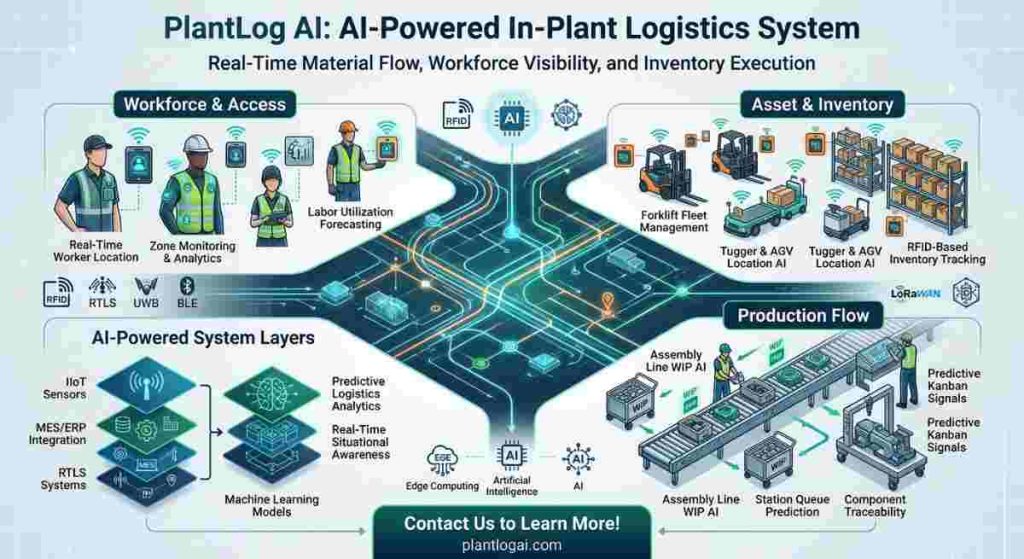
AI System Layers for In-Plant Logistics
Manufacturing facilities generate large volumes of operational data from RFID readers, barcode scanners, access control systems, RTLS infrastructure, wearable devices, BLE gateways, UWB anchors, environmental sensors, forklift telematics, AGV controllers, MES systems, ERP solution, WMS applications, PLCs, and industrial edge gateways.
PlantLog AI converts these data streams into operational System through multiple AI layers:
- Real-time situational awareness
- Predictive logistics analytics
- Material flow System
- Event correlation analytics
- Inventory forecasting
- Labor optimization modeling
- Congestion prediction
- Process compliance monitoring
- Production support analytics
- Decision-support recommendations
Machine learning models continuously analyze movement patterns, inventory consumption behavior, replenishment cycles, workforce activity, and equipment utilization to identify inefficiencies before they affect manufacturing performance.
Workforce & Access System
Personnel movement directly impacts internal supply chain efficiency. Material handlers, forklift operators, tugger drivers, warehouse associates, production operators, quality inspectors, contractors, and maintenance teams continuously interact with logistics assets and inventory throughout the facility.
Workforce & Access System provides visibility into worker location, movement behavior, authorization status, and operational engagement.
Worker Location System
Worker Location uses RTLS, BLE positioning, RFID badges, and UWB tracking technologies to provide real-time visibility into personnel activity across manufacturing and logistics zones.
Capabilities include:
- Real-time worker positioning
- Material handler tracking
- Operator location visibility
- Workforce distribution analysis
- Emergency evacuation accountability
- Labor deployment monitoring
- Travel-path optimization analysis
Zone-Based Presence Analytics
Manufacturing facilities contain operationally sensitive zones requiring continuous monitoring.
Examples include:
- Material supermarkets
- Kitting cells
- High-value inventory areas
- Clean rooms
- Temperature-controlled storage
- Production cells
- Packaging lines
- Shipping preparation zones
AI continuously evaluates worker presence, dwell times, entry frequency, occupancy density, and movement patterns to identify bottlenecks, compliance risks, and operational inefficiencies.
Shift Movement Pattern Analysis
Historical movement data provides valuable operational insights into workforce behavior and internal logistics execution.
AI analyzes:
- Shift change traffic patterns
- Material delivery routes
- Workforce circulation paths
- Operator travel distances
- Resource utilization trends
- Cross-functional movement patterns
These insights support lean manufacturing initiatives and value stream optimization efforts.
Labor Utilization Forecasting
Labor requirements often fluctuate according to production schedules, order backlogs, demand variability, and replenishment workloads.
Predictive AI models help organizations:
- Forecast staffing requirements
- Anticipate labor shortages
- Balance workforce allocation
- Improve shift planning
- Reduce overtime dependency
- Align labor with production demand
Biometric Gate AI Analytics
Entry and exit points generate operational data that extends beyond physical security functions.
AI evaluates:
- Workforce attendance trends
- Entry congestion
- Gate utilization rates
- Shift start performance
- Workforce arrival forecasting
- Access anomalies
These insights support workforce planning and operational scheduling.
Restricted Zone Compliance AI
Many manufacturing environments require controlled access to sensitive operational areas.
AI-driven compliance monitoring supports:
- Clean-room access verification
- Controlled inventory protection
- GMP compliance programs
- Quality-controlled production areas
- Regulatory access controls
- Critical infrastructure protection
Visitor & Contractor Access AI
Maintenance personnel, auditors, integrators, suppliers, and contractors frequently enter production environments.
AI supports:
- Authorization verification
- Access policy enforcement
- Movement monitoring
- Compliance auditing
- Visitor flow analytics
- Contractor accountability
Multi-Door Flow Optimization
Large manufacturing campuses often operate multiple access points for different workforce groups.
AI evaluates:
- Gate throughput
- Queue formation
- Entry-point utilization
- Pedestrian traffic density
- Shift congestion patterns
The resulting System improves facility-wide workforce circulation.
Asset & Inventory System
Asset visibility and inventory accuracy remain fundamental requirements for effective internal logistics operations.
PlantLog AI provides continuous System across mobile assets, material handling equipment, inventory containers, and production inventory.
Tugger & AGV Location AI
Tuggers and AGVs perform critical material movement functions between supermarkets, warehouses, and production areas.
AI-powered location System enables:
- Real-time fleet visibility
- Route optimization
- Delivery cycle analysis
- Traffic congestion avoidance
- Fleet utilization monitoring
- Mission completion analytics
UWB and RTLS technologies provide highly accurate positioning for dynamic production environments.
Forklift Fleet System
Forklifts remain among the most heavily utilized assets in manufacturing logistics operations.
AI evaluates:
- Vehicle utilization rates
- Travel efficiency
- Idle time patterns
- Congestion zones
- Operator productivity
- Battery charging behavior
- Material transport performance
Operational System improves equipment utilization while reducing unnecessary travel.
WIP Cart & Dolly Tracking AI
Work-in-progress materials frequently move through production areas using carts, dollies, racks, totes, and returnable containers.
AI-powered tracking provides:
- Real-time location visibility
- Route history analysis
- Dwell-time monitoring
- Missing asset detection
- Flow disruption identification
- WIP aging analysis
These capabilities improve production continuity and reduce inventory search time.
Real-Time Bin Location AI
Manufacturing operations require precise inventory visibility at the point of use.
AI continuously monitors:
- Bin locations
- Inventory movements
- Storage assignments
- Material consumption
- Stock availability
- Replenishment status
RFID, barcode scanning, BLE, and RTLS technologies automate inventory visibility while reducing manual inventory transactions.
Kanban Signal Prediction
Traditional replenishment systems react after inventory levels decline.
AI forecasting models predict:
- Future consumption patterns
- Replenishment timing
- Material demand variability
- Stockout risk
- Inventory depletion trends
Predictive replenishment improves line-side inventory availability while reducing excess inventory.
Supermarket Replenishment AI
Material supermarkets serve as strategic inventory buffers supporting manufacturing operations.
AI helps optimize:
- Inventory positioning
- Replenishment sequencing
- Material presentation
- Pick-path efficiency
- Storage density
- Inventory turnover
This enables faster material flow and improved production support.
Kitting Accuracy AI
Kitting operations play a critical role in high-mix and mixed-model manufacturing environments.
AI validates:
- Component selection accuracy
- Kit completeness
- Pick verification
- Sequence integrity
- Inventory reconciliation
Higher kitting accuracy reduces assembly disruptions and material shortages.
Cycle Count Optimization AI
Inventory verification activities consume significant operational resources.
AI prioritizes cycle counts using:
- Inventory movement frequency
- Variance history
- Consumption criticality
- Transaction anomalies
- Inventory risk scoring
This approach improves inventory accuracy while minimizing labor requirements.
Production Flow System
Production logistics performance depends on synchronized movement of materials, containers, inventory, and work orders.
Production Flow System provides visibility into how materials progress through manufacturing operations.
Assembly Line WIP AI
Work-in-progress inventory visibility is essential for maintaining manufacturing throughput.
AI monitors:
- WIP accumulation
- Flow velocity
- Production progression
- Material availability
- Station throughput
- Inventory aging
Early detection of bottlenecks helps prevent production interruptions.
Station Queue Prediction
Queue formation frequently indicates resource constraints or process imbalance.
AI models evaluate:
- Processing capacity
- Workload trends
- Resource availability
- Historical throughput
- WIP arrival patterns
Forecasting enables proactive intervention before bottlenecks impact output.
Production Order Sequencing AI
Production sequencing significantly influences logistics performance.
AI evaluates:
- Material readiness
- Inventory availability
- Resource constraints
- Changeover requirements
- Production priorities
Optimized sequencing improves both manufacturing throughput and logistics efficiency.
Component Traceability AI
Manufacturers increasingly require comprehensive digital traceability across production processes.
AI-enabled traceability supports:
- Component identification
- Material movement records
- Process verification
- Compliance documentation
- Recall investigations
- Quality root-cause analysis
RFID, barcode, and RTLS technologies create digital material histories throughout production lifecycles.
Lot & Serial Genealogy AI
Lot genealogy establishes relationships among raw materials, WIP inventory, assemblies, and finished products.
AI connects:
- Supplier materials
- Production batches
- Work orders
- Assembly records
- Finished goods
- Quality events
This genealogy supports compliance, quality management, and traceability requirements.
Cold-Zone Compliance Monitoring AI
Temperature-sensitive materials require continuous environmental monitoring throughout storage and production processes.
AI analyzes:
- Temperature readings
- Humidity conditions
- Exposure durations
- Compliance thresholds
- Sensor anomalies
- Corrective actions
LoRaWAN sensors, BLE environmental monitors, and edge analytics provide continuous visibility into controlled environments.
AI Decision Support for Internal Supply Chain Operations
PlantLog AI extends beyond visibility by providing operational decision support.
Capabilities include:
- Predictive replenishment recommendations
- Material shortage forecasting
- Congestion prediction
- Labor allocation optimization
- Inventory balancing recommendations
- Fleet dispatch optimization
- Resource prioritization guidance
- Exception management alerts
Machine learning models continuously improve prediction accuracy through ongoing analysis of operational performance.
ERP, MES, WMS, and Edge Integration
Effective AI System requires integration with enterprise operational systems.
PlantLog AI integrates with:
- SAP ERP
- Oracle ERP
- Manufacturing Execution Systems (MES)
- Warehouse Management Systems (WMS)
- Enterprise Asset Management (EAM)
- Quality Management Systems
- Access Control solution
- RTLS Infrastructure
- RFID Networks
- Industrial PLC Systems
The solution combines operational technology (OT) data with enterprise IT systems to create a unified digital representation of plant logistics activities.
Real-World Operational Applications
Automotive Supplier Operations
AI supports:
- Sequenced line feeding
- Tugger route optimization
- Returnable container visibility
- Forklift fleet coordination
- Kanban replenishment forecasting
Electronics Assembly Facilities
AI enables:
- Component traceability
- WIP visibility
- Inventory accuracy
- Kitting verification
- Production synchronization
Food Manufacturing Facilities
AI supports:
- Cold-chain monitoring
- Ingredient traceability
- Inventory visibility
- Material replenishment
- Workforce movement analytics
Industry Experience and Technical Expertise
PlantLog AI brings extensive Industrial IoT (IIoT), AI-powered manufacturing logistics, and smart supply chain technology experience, supported by thousands of successful deployments across manufacturing and logistics environments. Developed within Aperture Venture Studio with support from GAO, the solution draws on more than two decades of practical IoT implementation experience. Continued investment in research and development, rigorous quality assurance, and expert technical support helps deliver reliable industrial logistics solutions for complex manufacturing operations.
PlantLog AI’s technical leadership includes Ph.D.-level professionals from leading universities. Experience supporting Fortune 500 manufacturers, advanced research organizations, major universities, and government agencies throughout North America has helped shape its AIoT-enabled in-plant logistics system. The platform supports real-time workforce visibility, access control, industrial asset tracking, manufacturing inventory management, work-in-progress (WIP) monitoring, component traceability, and internal supply chain optimization. By combining AI in manufacturing, Industrial IoT, real-time asset tracking, and material flow optimization, PlantLog AI helps organizations improve operational visibility and coordinate manufacturing logistics more effectively.
Unified Operational System for Manufacturing Excellence
Efficient manufacturing logistics operations depend on accurate, real-time visibility into workforce activity, inventory levels, material movement, industrial asset utilization, and production flow. PlantLog AI combines artificial intelligence (AI), Artificial Intelligence of Things (AIoT), Industrial IoT (IIoT), RFID, Real-Time Location Systems (RTLS), Ultra-Wideband (UWB), Bluetooth Low Energy (BLE), LoRaWAN, edge computing, and enterprise system integration to deliver actionable insights across manufacturing facilities. This AI-powered in-plant logistics system helps manufacturers improve operational visibility, optimize factory logistics management, and strengthen internal supply chain performance.
By unifying workforce analytics, access governance, industrial asset tracking, manufacturing inventory management, line-side material replenishment, work-in-progress (WIP) monitoring, component traceability, and production flow optimization into a connected operational solution, PlantLog AI helps manufacturers improve inventory accuracy, coordinate material handling, optimize internal material flow, and support continuous manufacturing operations. These capabilities support AI in manufacturing, real-time inventory tracking, predictive inventory replenishment, smart manufacturing solutions, production logistics optimization, warehouse and factory coordination, and data-driven supply chain management.
Explore PlantLog AI’s AI, IoT, and intelligent automation solutions to learn how connected technologies can support smarter in-plant logistics and more efficient manufacturing operations. You can also explore Compentra AI as an external resource from our related website list.
Frequently Asked Questions About AI-Powered In-Plant Logistics
Learn how PlantLog AI supports manufacturing logistics through intelligent inventory management, workforce visibility, asset tracking, and production flow optimization.
1. What is an AI-powered in-plant logistics system?
An AI-powered in-plant logistics system uses artificial intelligence, connected sensors, location technologies, and operational data to improve the movement of materials, inventory, equipment, and people inside manufacturing facilities. PlantLog AI supports manufacturing logistics by providing insights into inventory visibility, material replenishment, workforce activity, asset utilization, and production flow.
2. How does PlantLog AI improve manufacturing logistics?
PlantLog AI brings together workforce and access insights, asset and inventory visibility, and production flow analytics. These capabilities help manufacturers identify logistics bottlenecks, improve material handling coordination, monitor inventory movement, support replenishment planning, and make more informed operational decisions.
3. Which AI functions support in-plant logistics operations?
AI functions described on the PlantLog AI page include real-time situational awareness, predictive logistics analytics, event correlation, inventory forecasting, labor utilization modeling, congestion prediction, process compliance monitoring, and decision-support recommendations. These functions help teams analyze operational patterns and identify potential inefficiencies.
4. What technologies does PlantLog AI use for asset and inventory tracking?
The platform's described technology ecosystem includes RFID, real-time location systems (RTLS), Ultra-Wideband (UWB), Bluetooth Low Energy (BLE), LoRaWAN, Wi-Fi HaLow, edge computing, and connected industrial devices. Depending on the deployment, these technologies can support material location visibility, inventory movement monitoring, asset tracking, and operational data collection.
5. Can PlantLog AI help with predictive inventory replenishment?
PlantLog AI describes AI-based forecasting for material consumption, replenishment timing, stockout risk, and inventory depletion trends. These insights can help manufacturing teams plan line-side replenishment, manage material supermarkets, and maintain better visibility into material availability.
6. How does PlantLog AI support workforce visibility and access control?
The Workforce & Access System describes worker location visibility, zone-based presence analytics, movement pattern analysis, labor utilization forecasting, and access compliance monitoring. With suitable location and access infrastructure, these capabilities can help organizations understand workforce distribution, monitor operational zones, and analyze movement patterns across a facility.
7. Can PlantLog AI track work-in-progress (WIP) materials?
PlantLog AI describes WIP tracking capabilities for carts, dollies, racks, totes, containers, and assembly-line inventory. WIP monitoring can provide visibility into material locations, dwell times, route history, inventory aging, and possible flow disruptions, helping teams identify issues that may affect production continuity.
8. How can AI optimize production flow and material handling?
AI-driven production logistics can analyze material availability, station queues, WIP accumulation, production priorities, and resource constraints. PlantLog AI describes functions for congestion prediction, production order sequencing support, forklift fleet analytics, AGV coordination, and material flow optimization to help teams make better-informed logistics decisions.
9. Does PlantLog AI support ERP, MES, and WMS integration?
The page describes integration with enterprise resource planning (ERP) systems, manufacturing execution systems (MES), warehouse management systems (WMS), enterprise asset management (EAM), quality management systems, access control systems, RFID networks, RTLS infrastructure, and industrial PLC systems. Specific compatibility and integration requirements should be confirmed with the PlantLog AI team for your facility.
10. Which manufacturing industries can use AI-powered in-plant logistics?
The page highlights applications in automotive supplier operations, electronics assembly, and food manufacturing. Related use cases include material replenishment, component traceability, kitting verification, returnable container visibility, WIP monitoring, and cold-zone compliance monitoring. The appropriate configuration depends on each facility's processes and technology infrastructure.
11. How does AI improve manufacturing inventory management?
AI can analyze inventory movement, consumption patterns, variance history, material criticality, and replenishment cycles to help teams prioritize cycle counts, identify potential shortages, and improve inventory visibility. PlantLog AI describes inventory forecasting, RFID-based tracking, bin location monitoring, and predictive replenishment as part of its in-plant logistics capabilities.
12. How can we learn more about PlantLog AI for our facility?
Visit the AI, IoT, and intelligent automation page to explore related connected-manufacturing concepts. To discuss your facility's workforce visibility, asset tracking, inventory management, or production logistics requirements, contact the PlantLog AI team through the contact page.